Field note · 8 October 2026 · The town at the gate
Kuba Camii in Selçuk: the little mosque shaped like a tomb
It stands in a small park across the road from the bus station, and a few hundred people walk past it every day without looking up. Here is what it is, and why its shape is a puzzle.
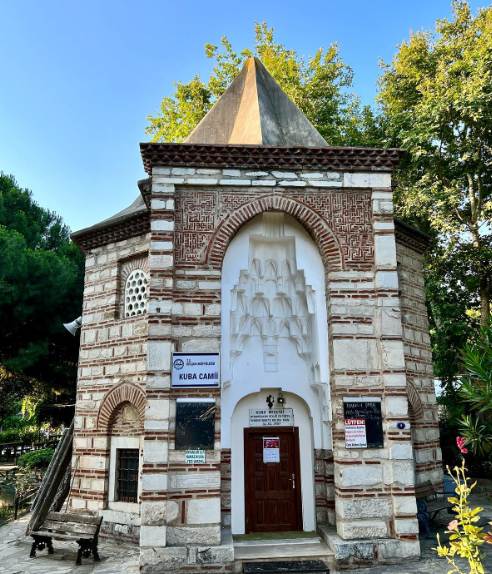
Kuba Camii — written Kuba Mescidi on some maps, and listed in Türkiye’s heritage inventory as the Kümbet Mescidi — is a small octagonal prayer house in Selçuk, İzmir province, standing in a little park across the road from the bus station. It is not the Quba Mosque in Medina. It is dated to the fourteenth century, it is still used for prayer, and its architecture is not a mosque’s at all. It is a tomb’s.
Almost nobody stops. The minibus stand is a minute away, the Saturday market fills the streets behind it, and people walk past this building all day on their way to somewhere else. Tripadvisor has it forty-eighth of fifty-seven things to do in Selçuk, on two reviews. That tells you how much attention it gets. It tells you nothing about whether it has earned any.
We think it is worth five minutes, and the five minutes are stranger than the size of the thing suggests. Stand in front of it and you are looking at a puzzle: a doorway built for a monument, attached to a room you could cross in a few steps.
Written by the Gezginol guide team, licensed Ephesian guides. Sources: the Turkish heritage inventory and the academic work listed at the end. Last reviewed: October 2026.
Where Kuba Camii is, and how to find it
In a small park in Atatürk Mahallesi, effectively across the road from Selçuk bus station — about seventy-five meters door to door, which is a minute at a stroll. If you have arrived in Selçuk by bus or by dolmuş, you have already been within sight of it.
From there: the Ephesus Archaeological Museum is three or four minutes on foot, the train station about eight, and the İsa Bey Mosque about ten, uphill. The Saturday market sets up in the same block of streets, so if you are already coming for market day, the mosque is a two-minute detour from the stalls. Our free self-guided walk through Selçuk passes the end of its street.
| From | On foot |
|---|---|
| Selçuk bus station (otogar) | about 1 minute |
| Ephesus Archaeological Museum | 3–4 minutes |
| Selçuk train station | about 8 minutes |
| İsa Bey Mosque | about 10 minutes, uphill |
A mosque with the body of a tomb
This is the part worth the detour. Türkiye’s Kültür Envanteri — the heritage inventory — puts it flatly: although the building is used as a mescit today, its architecture is that of a kümbet-style tomb. The inventory files it under three types at once, türbe / kümbet / mescit, and that hedging is the honest position.
Look at what it is not. It is eight-sided, where a small mosque would be square. It is roofed with a faceted point, where a mosque would carry a dome. It has no minaret. A kümbet is a tomb tower, usually polygonal, usually with a burial chamber beneath the room you stand in. Every one of those features belongs to a tomb and none of them is anything a neighborhood prayer room needs.
Whether a burial chamber still survives underneath, we cannot tell you. No report we can reach says, and the 1997 restoration does not appear to have been published.
There is a name attached to the idea, and it should be handled carefully. The inventory records a claim — iddia edilmektedir, "it is claimed" — that the tomb may be that of Halil Yahşi Bey, citing a paper by the art historian Şakir Çakmak on the tombs of Selçuk. Halil Yahşi Bey was an Ottoman commander under Murad II and the first governor of Aydın after the Aydınoğulları principality ended in 1426. If that attribution were right, the building would be fifteenth-century Ottoman rather than fourteenth-century Aydınid — which is presumably why the inventory dates it to the fourteenth or fifteenth century and leaves it there. A claim, not a conclusion.
How old is Kuba Camii, really?
Fourteenth century is the usual answer, and it is probably right. But it is worth knowing what that date actually rests on, because it is not what most visitors assume.
There is a marble plaque over the door giving the fourteenth century and the Aydınoğulları, and recording that the building reopened for worship on 4 April 1997 after restoration. That plaque is modern. The restorers put it there. It is a summary of scholarly opinion, not a medieval record.
The nearest thing to a verdict comes from the one monograph-length study of the subject: Tarık Uğur’s 2006 master’s thesis at Ege University on the mosques and mescits of Selçuk. Of the nine buildings it examines, only one — the İsa Bey Mosque, 1375 — carries a dated building inscription. The other eight, this one among them, are dated by their style and their setting. So when you read "fourteenth century" on a sign here, read it as a careful art-historical judgment rather than a document.
The genuinely old inscription on the building is the one laid in brick in the spandrels above the portal arch, in angular Kufic letters. What it says, as far as we have been able to find, nobody has published.
Two names, and the one nobody can explain
The building answers to two names, and only one of them makes sense.
Kümbet Mescidi is the inventory’s name and it is self-explanatory: the little mosque shaped like a tomb tower. Kuba Mescidi, or Kuba Camii, is what the sign on the wall says and what the maps show.
Where "Kuba" comes from, we do not know, and we have not found anybody who does. Two explanations circulate locally — that it borrows the name of the Quba Mosque in Medina, the first mosque in Islam, or that it is simply how kubbe, dome, came to be said here — and we can find no source that settles it either way. We would rather tell you that than pick the prettier story. If you are a historian of the Aydın beylik and you know the answer, write to us and we will correct this page with thanks.
What to look at when you are standing in front of it
Five minutes, and mostly from the outside.
- The portal, first. It projects from the facade and rises above it, taller and broader than the building has any need of. A crown door on a garden shed. Whoever paid for this wanted it seen.
- The muqarnas inside the arch. That white honeycomb of stepped niches is the signature of the period, carved to break the light into tiers. On a building this small it is close enough to read properly, which it rarely is on a large mosque.
- The brick Kufic. In the panels flanking the arch, the brickwork itself forms angular letters and geometry — writing built out of masonry rather than cut into it.
- The sawtooth cornice. Bricks set corner-out along the eaves, throwing a zigzag of shadow in the afternoon.
- The banding. Courses of red brick alternating with pale stone, all the way around the eight sides. Cheap, fast, and better looking than it had to be.
- The windows. Two tiers of small ones, including a pierced stone grille that throws a geometric pattern onto the floor inside when the sun is right.
- The roof. Faceted and pointed, following the eight sides up to a cap. Not a dome. That is the tell.
Visiting: what we tell our guests
This is a working neighborhood mescit, not a monument with a ticket desk. There is no entrance fee and no published opening time, and we would not want you to plan a day around getting inside.
- If the door is open and it is not prayer time, you may go in. Shoes off at the step.
- Shoulders and knees covered; women cover their heads. The same rules we give for Meryem Ana Evi and the İsa Bey Mosque.
- Do not walk in during a prayer, and do not photograph people praying.
- There is an ablution fountain beside the building. It is for worshippers, not a drinking fountain.
- If it is locked, you have lost nothing. The portal is the best thing about it and it faces the park.
None of that is posted on a sign. It is simply how we behave when we bring guests here, and how the neighborhood would expect you to.
The other small mescits of Selçuk
Kuba is not alone. The same century that raised the İsa Bey Mosque left a scattering of much smaller prayer houses around the southern slope of Ayasuluk Hill, and most visitors never learn they exist.
The Aydınoğlu Mescidi is the closest, a couple of minutes away on Atatürk Caddesi, square-planned and sitting about a meter below the modern road — a plain measure of how much the town has risen since it was built. The Alpaslan Mescidi faces the entrance to the Basilica of St John. The İshak Bey Mescidi, rebuilt in 1648 on an older footing, keeps its earlier minaret standing apart from it. Others — Akıncılar, Kılıçarslan, Karakol Yanı — are easy to walk past.
Taken together they are an hour’s wandering, and they tell you something the big monuments do not: that this was an ordinary working town under the Aydınoğulları, with neighborhoods that each wanted their own small place to pray. For the wider picture of the town, see our guide to Selçuk, the town at the gate of Ephesus, or the list of things to do in Ephesus beyond the ruins.
Fitting it into a day
Kuba Camii is a five-minute stop, not a destination. It works best bolted onto something else: the museum, which is minutes away; the market on a Saturday morning; or the walk up to the basilica and Ayasuluk Fortress. If you are arriving or leaving by bus with time to kill, it is the most interesting thing within a minute of the terminal by a wide margin.
Our Selçuk in a Day tour covers the town properly — basilica, mosque, museum, market — with a licensed guide, private car and driver, hotel pickup and the entrance tickets included, from €39 per person for groups of 8 or more (smaller groups get a private quote). Small things like this one are the reason we prefer a day in Selçuk to a rushed hour.
Kuba Camii itself costs nothing to see, which makes it an easy thing to recommend. Ephesus is the opposite: it has a gate, a queue and a ticket. And we add nothing to the ticket. The fast pass is ours to give; the entrance fee stays exactly what the Ministry of Culture and Tourism charges at the gate, to the lira. You are paying us for the queue you skip — never for the ticket itself.

Kuba Camii FAQ
What is Kuba Camii in Selcuk?
A small octagonal prayer house in the center of Selçuk, İzmir province, dated to the fourteenth century and still in use. It is also called Kuba Mescidi, and the national heritage inventory lists it as the Kümbet Mescidi. Its architecture is that of a tomb rather than a mosque.
Is Kuba Camii the same as the Quba Mosque in Medina?
No. They are unrelated buildings. The Quba Mosque in Medina is the first mosque in Islam. This is a small fourteenth-century mescit in Selçuk, Türkiye, beside the Ephesus ruins. Nobody has published an explanation of why the Selçuk building carries the name.
How old is Kuba Camii?
It is dated to the fourteenth century, the Aydınoğulları period, but that date rests on the building’s style and on a marble plaque the restorers set over the door, not on a medieval foundation inscription. The heritage inventory hedges it as fourteenth to fifteenth century.
Can you go inside Kuba Camii?
It is a working neighborhood mescit, not a museum. There is no ticket and no posted opening time. If the door is open and it is not prayer time you may go in: shoes off, shoulders and knees covered, heads covered for women. The outside is the better half in any case.
Where is Kuba Camii and how do I get there?
In a small park in Atatürk Mahallesi, essentially across the road from Selçuk bus station — about a minute on foot. The Ephesus Museum is three or four minutes away, the train station about eight, and the İsa Bey Mosque about ten.
Sources & further reading
- Kültür Envanteri: Kümbet Mescidi, Selçuk — inventory record 19117 (Turkish)
- Turkish Archaeological News: “Small mosques from the Aydınid period in Selçuk”, an extract from the guidebook The Secrets of Ephesus
- Tarık Uğur, Selçuk (Ayasuluk) Cami ve Mescitleri, MA thesis, Ege University, 2006 (Turkish; thesis no. 205271)
ONE MESSAGE, ONE PLAN
Tell us your date.
We’ll tell you the plan.
A licensed local guide replies personally — usually the same day, from info@ephesusbylocals.com.
TÜRSAB license 15746 · Nothing paid in advance · Skip-the-line tickets held for you