The whole walk · downhill, in order
Walking Ephesus, gate to harbor
Eight stops, about a kilometer and a half, downhill all the way. This is the walk our guides actually lead through Ephesus — monument by monument, in the order you meet them, with the reasons for the route.
- UNESCO World Heritage
- Founded 10th c. BC
- Peak population 34,000–72,000 (est.)
- 1.5 km walk, downhill
- Allow 3–4 hours
Ephesus was, for around six centuries, one of the great cities of the Mediterranean world — capital of Roman Asia, home by modern estimates to roughly 34,000–72,000 people (not the 200,000–250,000 of older guidebooks), host to a temple counted among the Seven Wonders, and a port whose harbor brought grain, marble and Christianity to Anatolia. Today it is an archaeological site of about 2 kilometers of excavated streets in Selçuk, 25 minutes from the cruise port at Kuşadası and roughly an hour from İzmir. Only an estimated fifth of the ancient city has been dug; what has been uncovered is still one of the most complete Roman cities you can walk through anywhere.
Walk it the way we do — enter at the upper gate and go downhill — and the city tells itself in the right order: politics at the top, private wealth in the middle, commerce and spectacle at the bottom, the sea at the end.
The walk · eight stops, downhill
Ephesus, in the order you meet it
Stop 01
The Odeon & the State Agora
Enter at the upper gate and the first ruin you meet is the prettiest small building in Ephesus: a roofed odeon of around 1,400 seats where the city council met and, on better evenings, concerts happened. Its orchestra floor is still laid in pale marble. Beside it stretches the state agora — the civic square, where the city governed itself rather than traded — and the paving still carries the outline of a temple to Isis. Stand at the top row and you see the whole plan of the upper city at once. This is where a good guide draws you the map before you walk it.

Stop 02
Curetes Street
The spine of the city, and the reason people fall in love with Ephesus. Curetes Street runs downhill between colonnades, past shopfronts, fountains, statue bases and mosaic pavements that were the pedestrian arcades of the Roman world. The marble is polished by two thousand years of feet and genuinely slippery — this is the one place we ask guests to look down as much as up. Watch for the gouged cart ruts, the game boards scratched into the paving, and the marble that changes color where the ancient shade fell.

Stop 03
The Temple of Hadrian
The most photographed facade in Ephesus after the library, and the most rewarding to have explained. Four columns, a delicate arch, and a Medusa head set into it to turn away evil — with a frieze below telling the city’s foundation myth, boar hunt and all. Everything you see here is a cast; the originals are in the Ephesus Museum in Selçuk, which is exactly why we send people there afterwards.

Stop 04
The Terrace Houses
A separate ticket, a separate world, and in our honest local opinion the most underrated sight in Turkey. Under a modern roof, glass walkways carry you above seven Roman villas belonging to the city’s wealthiest families — with mosaic floors, marble-paneled halls, frescoed walls in still-bright red and blue, private baths and even a domestic water and heating system. Everywhere else in Ephesus you imagine how people lived. Here you simply look at it.

Stop 05
The Library of Celsus
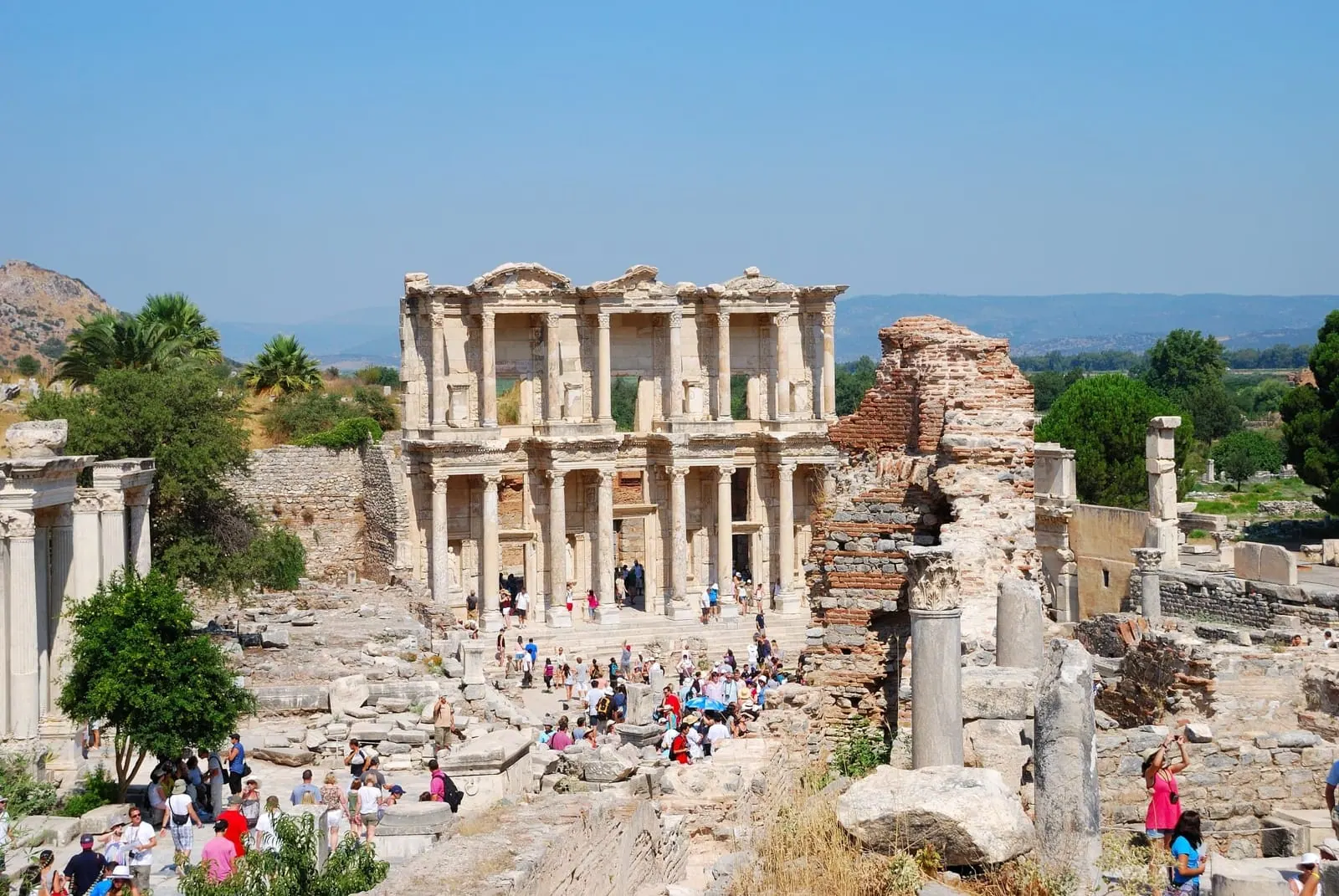
The face of Ephesus on every poster, and it earns it. Built around AD 110 by a consul’s son as a tomb and a library for his father — Celsus is still buried in a marble sarcophagus beneath the floor — it held up to 12,000 scrolls in a double-walled chamber designed to keep out damp. The facade you see was pieced back together from fallen fragments in the 1970s, and its columns are deliberately fatter in the middle and its podium curved, an optical trick to make the whole thing look larger than it is. It works on everyone, still.
Stop 06
The Commercial Agora
Beside the library, a triple-arched gate built by two freed slaves who had made good — Mazaeus and Mithridates — opens into the commercial agora: a great square that was the trading floor of one of the Mediterranean’s busiest ports, ringed by shops and shaded colonnades. Somewhere in this square, silversmiths made shrines of Artemis, and one of them started the riot that fills Acts 19. Stand in the middle of it and you are standing in the marketplace Paul knew.

Stop 07
The Great Theater
Twenty-five thousand seats cut into Mount Pion, one of the largest theaters in the ancient world when it was finished, and still capable of carrying an unamplified voice to the top row — we always test it, and it always startles people. This is the arena where the crowd shouted "Great is Artemis of the Ephesians!" for two hours against Paul’s preaching. Climb as high as your knees allow: from the upper rows the whole city, the harbor street and the silted plain that was once the sea lie open in one view.

Stop 08
Harbor Street (the Arcadian Way)
From the theater, a broad colonnaded avenue runs dead straight toward what used to be the sea — 500 meters of marble that was lit by fifty street lamps at night, a rare luxury in the Roman world. Today it ends in a green plain: the Küçük Menderes river silted the harbor up and slowly strangled the city. Standing at the theater looking down it is the moment Ephesus’s whole rise and fall makes sense in one glance.

A very short history, for standing still in
Legend gives the founding to Androklos, an Athenian prince who was told by an oracle that a fish and a boar would show him where to build — and, the story goes, a fish leapt from a fire, sparked a bush, and a startled boar ran to the spot. Archaeology gives a duller and older answer: settlement here goes back to the Bronze Age, when this was Apasa, capital of the kingdom of Arzawa.
The city’s fortunes moved with its harbor and its goddess. Croesus of Lydia took it in the 6th century BC and funded the great Temple of Artemis; Alexander arrived in 334 BC; and under Rome, from 129 BC, Ephesus became the capital of the province of Asia and one of the empire’s largest cities. Hadrian visited, Augustus poured money in, and the city swelled — modern estimates put its Roman-era population at somewhere between 34,000 and 72,000, well short of the quarter million once claimed.
Christianity took root early and deeply. Paul lived and preached here for over two years in the 50s AD, provoking the silversmiths’ riot in the Great Theater; tradition brings John the Evangelist here in his old age, and with him — in the belief that has made the House of the Virgin Mary a place of pilgrimage — Mary herself. In AD 431 the Third Ecumenical Council met in the Church of Mary inside the city walls.
And then the sea left. The Küçük Menderes silted the harbor steadily; earthquakes, a Gothic raid, malaria in the marshes and the shifting of trade did the rest. The population drifted uphill to the Ayasuluk hill in what is now Selçuk, and the marble city was left to the fields. Excavation began in 1869 and has never stopped — which is why the Ephesus you visit next year will not be quite the Ephesus of this one.

Practical things worth knowing
- Two gates. Upper (Magnesia) and lower. Go in at the upper, out at the lower, and have your transport meet you — walking uphill wastes the best hours of the day.
- Opening hours. From 08:00 every day. In summer the lower gate stays open until about 19:00; in winter the site closes at 18:00, with the last ticket at 17:30. The hours shift with the season — we confirm your exact date when you write.
- And after dark. In summer the site also opens as a floodlit Night Museum, Wednesday to Saturday, 19:00–23:00 (1 June to 1 October in 2026) — cooler, emptier and, in high summer, the better visit.
- Tickets. The main site and the Terrace Houses are separate tickets; a museum card covers repeat entry if you are touring Turkey for a while. Arriving alone you buy them at the gate or online — on any of our tours we obtain them in advance with an agency priority pass, so you skip the ticket queue and still pay only the official price.
- Shade is scarce. There are almost no trees on the main street. Hat, water and real shoes; the marble is slick and uneven in the smoothest places. Check the live 15-day forecast and what to wear before you pack for the day.
- Timing beats everything. Between about 10:30 and 14:30 in high season the site fills with tour groups. First entry or late afternoon is a different city — the reason our opening-hour walk exists.
- Nearby, in 15 minutes: the House of the Virgin Mary in the hills, the Basilica of St John, the last column of the Temple of Artemis, and the Ephesus Archaeological Museum — all covered in our guide to Selçuk.
- Arriving by ship. Ephesus is 19 kilometers from the Kuşadası quay, about twenty-five minutes by road; for the hours on either side of the ruins, see our list of things to do in Kusadasi.
- Restrooms. There are restrooms at both gates and almost none in between, so use them before you set off. At the upper gate they are signposted beside the souvenir stalls, which also sell sun hats and scarves if one got left at the hotel.

Questions we hear on the marble
How long do you need at Ephesus?
Two to three hours for the main city at a sightseeing pace, plus 30 to 45 minutes if you take the Terrace Houses; with a guide who stops to explain, allow three to four. Under two hours you are hurrying, though a focused two-hour walk still reaches the library and the theater. A full day lets you add the House of the Virgin Mary, the museum and a proper lunch. See our field note on how long to visit Ephesus for the full honest schedule, cruise sprint to full day.
Is Ephesus wheelchair or pushchair friendly?
Partly. The main route down Curetes Street is walkable but the paving is ancient marble, sloped and uneven, and the Terrace Houses are stairs and walkways only. Tell us in advance and we will plan a gentler route, shorter distances and the right gate — our field note on whether Ephesus is wheelchair accessible sets out the ground stretch by stretch.
Is there a dress code?
Not for the ancient city — dress for heat and walking. Modest dress (covered shoulders and knees) applies at the House of the Virgin Mary and at İsa Bey Mosque in Selçuk. The full list, including what you may touch and whether tripods and drones are allowed, is in our note on the Ephesus dress code and site rules.
Can you see Ephesus without a guide?
Yes, you can walk it freely, but the site is signed sparsely and most of what makes it extraordinary is invisible in the stone. Our honest answer, including when to skip a guide, is in do you need a guide at Ephesus; for choosing one, see how to hire a guide well.
How many people lived in ancient Ephesus?
No census survives, so every number is a modern estimate. Studies that measure the city’s lived-in area put Roman Ephesus at about 34,000–56,000 people, a 2017 model based on house counts puts it nearer 72,000, and one high-density estimate reaches 172,500. The 200,000–250,000 you’ll read in older guidebooks goes back to an 1886 guess, an inscription read too generously, and the old habit of multiplying the Great Theater’s 25,000 seats by ten. Whichever figure you trust, Ephesus still ranked among the five largest cities of the Roman world.
What is the Grotto of St Paul, and can we go up to it?
Not for now: the grotto is closed to visitors for conservation, and no reopening date has been announced (October 2026). A narrow cave some fifteen meters deep on the northern face of Bülbül Mountain, it served Christians as a chapel for centuries, and on the walk our guides still tell what conservators found there in 1998. Under a later layer of plaster was a painting from around the sixth century: Paul teaching, young Thecla of Iconium hearing him from her window, and her mother Theoclia reacting in alarm. The painter gave Thecla the same height and the same teaching gesture as Paul; someone in a later age gouged out her eyes and that raised hand. Its balding, dark-bearded Paul is one of the earliest known likenesses of the apostle anywhere. Around it, Byzantine-era visitors scratched hundreds of pleas for his help. Whether Paul ever set foot in the cave, no one can prove.
Sources & further reading
- UNESCO World Heritage Centre — Ephesus (inscribed 2015)
- Austrian Archaeological Institute (ÖAI) — Ephesos excavations
- Turkish Ministry of Culture and Tourism — museums and sites
- Britannica — Ephesus
- Warden & Bagnall, "The Forty Thousand Citizens of Ephesus" — Classical Philology, 1988
- Hanson & Ortman — population model of Roman Ephesus, Journal of Roman Archaeology, 2017
The ships we meet
We bring people back on time.
Guests from these cruise lines have walked Ephesus with us for over twenty years. Not one of them has missed a ship — we plan every shore day backwards from your all-aboard time.

ONE MESSAGE, ONE PLAN
Tell us your date.
We’ll tell you the plan.
A licensed local guide replies personally — usually the same day, from info@ephesusbylocals.com.
TÜRSAB license 15746 · Nothing paid in advance · Skip-the-line tickets held for you