Field note · 14 September 2026 · Our home valley
The olive harvest in Selçuk, from the first net to the new oil
In autumn the lanes around Selçuk fill with white nets. Here is how the olives come down, where they go, and where a visitor can taste the new oil.
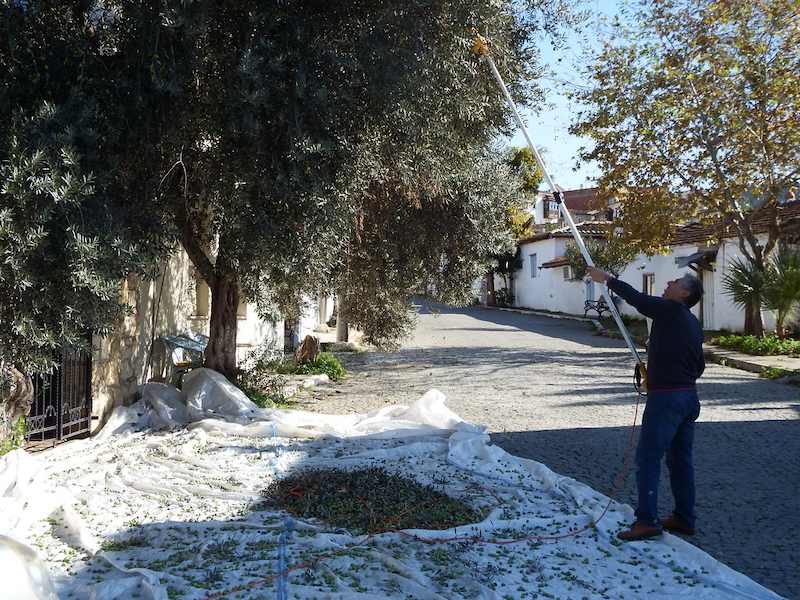
The olive harvest in Selçuk runs from about October to December, and for those weeks the lanes and hillsides around the town are spread with white nets. Green olives for the table and for sharp early-harvest oil come down first; most of the fruit grown for oil stays on the tree to ripen and is picked through November and December. Families bring the olives down by hand or with powered combs on long poles, fill sacks and crates, and take them to the mill, where the pressing is paid for by the kilo or with a share of the oil. Under Turkish food law, only oil extracted below 27°C may be labeled cold-pressed. The olive this stretch of the Aegean is known for is Memecik, and its oil from neighboring Aydın province carries a protected designation of origin in both Türkiye and the European Union.
We live twenty minutes down the road in Kuşadası, and every autumn the talk in both towns turns to nets, mills and whose oil came out greener. This is the harvest as it looks from the lane: how the olives come down, what happens at the mill, and where a visitor can taste the result.
When is olive harvest season in Selçuk?
The weeks move with the variety and with the season’s temperatures, but the order never changes. Fruit for green table olives and for early-harvest oil is picked first, from the last days of September into October, and on the coast the first week of October is the classic moment. Black olives follow from October into December. Olives grown for oil are left until no green fruit remains on the tree and the oil content has peaked, and by then there is a net under almost every tree in the valley.
How the nets go down
A sheet of netting or tarpaulin goes under the tree first, sometimes straight across the street when an old tree leans over a village lane, as in the photograph above. Then the fruit is brought down onto it. Picking by hand is the gentlest method and gives the best oil. Powered combs on long poles work far faster, which is why so many families now use them. Beating the branches with sticks is discouraged, because it damages the shoots that carry next year’s crop, and olives left to fall and gathered off the ground make oil with high acidity.
It is long, bending work, and it is paid by the day. For the 2024 harvest the chamber of agriculture in Didim, down the coast in Aydın province, set the day rate at 900 lira for picking, starting at 08:00, and 1,400 lira for shaking the trees.
Memecik, the olive of the southern Aegean
Memecik is an oily fruit, and its oil runs from green to golden yellow, with a strong fruity smell and a bitter, peppery finish that catches the back of the throat. Selçuk itself belongs to İzmir province, but just to the south, across the line in Aydın, where Kuşadası sits, the oil has a name of its own. Aydın Memecik Zeytinyağı was registered in Türkiye as a protected designation of origin in 2020 and entered in the European Union’s register of protected names in 2024. Its specification demands at least 100 mg/kg of total phenolic compounds, the chemistry behind that peppery bite.
At the mill
Once an olive is off the tree, the clock is running. The California Olive Oil Council puts the rule plainly, and it holds just as well on this coast: fruit not milled within 24 hours of picking will not make extra virgin oil. A modern mill works as a continuous line. The olives are washed, crushed to a paste, slowly mixed and spun in a centrifuge that separates the oil from the water and pulp. Selçuk has had a modern mill of its own since 2015.
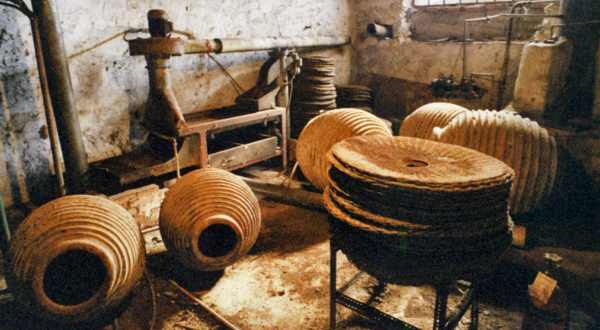
Paying for the pressing works one of two ways: by the kilo, or with a share of the oil. For the 2022 harvest the municipal mill in Çine, inland in Aydın province, charged 80 kuruş a kilo, or kept 7 percent of the oil instead. The words on the label are fixed by law as well. Under the Turkish Food Codex, soğuk sıkım (cold extraction) may only describe oil from olive paste kept below 27°C in a centrifuge or percolation system, and ilk soğuk baskı (first cold press) only oil squeezed below 27°C in a hydraulic press, the older system of stacked mats in the photograph below.
The olive tree the Ephesians took to Rome
Olives were part of this valley’s story long before the mills. In AD 22 envoys from Ephesus argued before the Roman Senate that Apollo and Artemis were born not on Delos but in the Ephesians’ own grove of Ortygia, where Leto gave birth holding on to an olive tree that, they insisted, was still growing there. Tacitus wrote the claim down. Inside the city, one household in the Terrace Houses kept a running account on a plaster wall, and olive oil sits on the list beside wine, bread, meat and firewood. It is the kind of small, human detail that makes the ancient city feel lived in.
Where visitors can taste the new oil
A mill in full season is a working plant, so the easiest places to taste this valley’s oil are at the table and in the village.
At lunch. On our Ephesus days the long Aegean table is built on olive oil: white beans, stuffed vine leaves and wild-herb mezes cooked in it and served cool, the style called zeytinyağlılar. Wipe the plate with bread; that is what the bread is for.
In Şirince. The hill village above Selçuk sells olive oil and olive-oil soap along its lanes. Buy a small bottle of green, peppery early-harvest oil and a softer, riper one, and taste them side by side at home. Our notes on Şirince cover the rest of the village, and the Ephesus and Şirince day gives you an afternoon there.
At the Saturday market. Selçuk’s weekly market is where the town does its own shopping, with olives sold from the bucket. Our guide to the town and our day in Selçuk cover the basilica, the mosque and the market streets.
When you buy oil to carry home, choose this season’s over last year’s, because olive oil does not improve with age, and look for the protected-designation emblem if you want Aydın Memecik in particular. Our guides know where to find the best oil in the valley and are glad to point you to it.
Harvest weeks overlap the last of the cruise season in October. Our full-service days run €37–57 per person with a licensed guide, a private air-conditioned car, a driver, hotel or port pickup, parking and taxes. Every day that visits Ephesus includes lunch, and priority entrance is arranged in advance so the ticket queue is not part of your morning. Entrance fees, personal drinks and tips are paid separately. Check the 15-day forecast for Ephesus before an autumn visit and pack a layer.
Questions people ask about the olive harvest
When is olive harvest season in Turkey?
Along the Aegean around Selçuk it runs from about October to December. Green olives for the table and for early-harvest oil come first, from late September into October; black olives and most olives grown for oil follow into December. The exact weeks move with the region and the season’s temperatures.
How is olive oil harvested?
Nets are spread under each tree and the olives are brought down onto them, by hand or with powered combs on long poles, then taken to the mill, ideally within 24 hours. Hand picking is the gentlest method and gives the best oil. Beating the branches with sticks damages next year’s shoots, and olives gathered off the ground make high-acidity oil.
What is early harvest olive oil?
Oil pressed from olives picked green in autumn, before they ripen toward black. Green olives hold less oil, so each bottle takes more fruit, and the oil tastes grassy, bitter and peppery. Its higher polyphenol content also tends to give it a longer shelf life.
Where can you do olive oil tasting in Selçuk?
The simplest places are the lunch table, where Aegean vegetable dishes are cooked in olive oil and served cool, and the olive-oil shops of Şirince, the hill village above the town. A mill in full season is a working plant rather than a tasting room, so taste at the table and buy in the village.
Sources & further reading
- Kültür Portalı (T.C. Ministry of Culture and Tourism) — Aydın Memecik Zeytinyağı
- TÜRKPATENT Geographical Indications Portal — Aydın Memecik Zeytinyağı, registration no. 535
- Resmî Gazete — Turkish Food Codex Communiqué on Olive Oil and Olive Pomace Oil (2017/26)
- Tacitus, Annals 3.61 (LacusCurtius, University of Chicago)
21:00 · ONE MESSAGE, ONE PLAN
Tell us your date.
We’ll tell you the plan.
A licensed local guide replies personally — usually the same day, from info@ephesusbylocals.com.
TÜRSAB license 15746 · Nothing paid in advance · Skip-the-line tickets held for you